



- In the month of Fertility, IVI shares the pillars on which its success is based
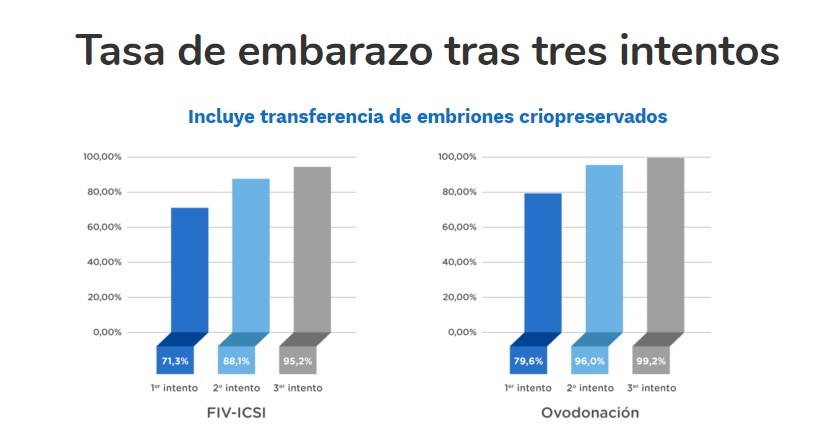
- Lat cumulative rate after three attempts at fertilization invite and egg donation is very close to 100%
Ensure safety of patients at every step, achieve the impossible, bet on the research cutting edge and learn to control the time to count on the better success rates, are the four differentiating elements to offer assisted reproductive treatments quality, something that only the best fertility clinics can guarantee.
The month of fertility is our month, when we celebrate with more enthusiasm the miracle of motherhood, and this year is special because We reached 30 years fulfilling the dreams of our patients. That is why we want to tell you what the ingredients of this miraculous recipe are.
Safe assisted reproduction
We live in the age of security, exacerbated by the deadliest pandemic of this century. XXI. The return to fertility treatments in clinics has been orchestrated by a few comprehensive security measures. More than fifteen measures contemplate the safety protocol of all IVI clinics. In addition to the basic ones (gloves, masks, protection screens, hydroalcoholic gel …) all our laboratories are equipped, for many years, of the processes required to work with type 2 infectious agents like the Zika virus or HIV and, of course, the SARS-CoV-2. In these moments of uncertainty due to COVID-19, all our patients (both women and men) are subjected, at each step of the assisted reproduction process, to diagnostic tests to rule out the presence of Coronavirus and check if there is immunity or not.
Obtaining a healthy baby, and the safety of the mother in its treatment, are the maxims of IVI. Safety summed up in the two fashionable acronyms SET (single embryo transfer) and PGT (preimplantation genetic diagnosis, also for its acronym in English). Ensuring the same or higher success rate with a single embryo transfer is something that only the most specialized clinics can offer. IVI has reduced the twin pregnancy rate by 75% in the last ten years, due to the risks (prematurity, low birth weight, hypertension…) that these entail. And the commitment to the safety of our patients and their babies has made increase our SET rates up to 84.8% per cycle in IVF and 88.2% in egg donation. Also increasing the rate of preimplantation genetic diagnosis, for the detection of genetic and chromosomal alterations and the prevention of transmission of serious diseases, and obtaining up to 73.4% accumulated gestation rate.
You can see more advantages over the transfer of a single embryo in this video
We could not close the security chapter without mentioning the Matcher, the barcode and scanner system that guarantees the correct traceability of all our samples (in all our centers) neither him screening test for monogenic diseases that we apply to all our donors, essential to ensure the absence of genetic risk in gamete recipients.
Complicated medical cases in IVI
Achieving the impossible is not a chimera when we observe our pregnancy rate (see graph below), regardless of the number of previous treatments of a patient until reaching our clinics. From one to five or more previous attempts, we found an average pregnancy rate greater than 50%. This means that, regardless of the previous history, or the complexity of the previous treatments, we will get our patients pregnant..
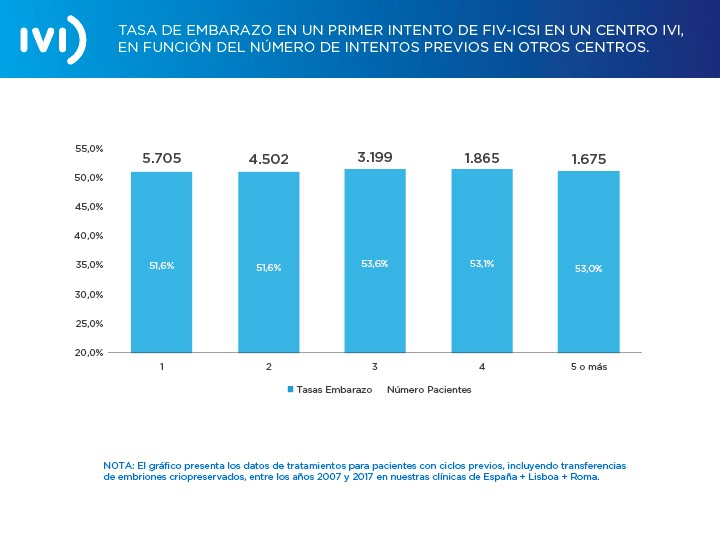
Did you know that IVI it was one of the clinics pioneers in having their data audited by a third party? Did you know that all IVI data are validated annually by SGS, the world leader in inspection, verification, testing and certification? This allows us to be extremely precise when comparing our data with that of the SEF (Spanish Fertility Society), and in this comparison we extract data as conclusive as that Our implantation rate with our own oocytes is almost double the national average in most of the Autonomous Communities and the gestation rate is around 15% higher than the average..
Helping our patients to fulfill their dream of being mothers, regardless of their previous treatment history, nor the complexity of their case, is close to achieving the impossible. We know how arduous and long the road to motherhood can be at times, that’s why We want to collaborate with all our patients in economic and emotional savings, facilitating their dream of being mothers in the shortest possible time..
Research and success rates in IVI
More than 1,900 researchers, 28 laboratories in 9 countries, 15 lines of research, around 150 annual publications, with a single goal: our patients. The investigation is our engine, we could not guarantee safety standards or dream of achieving the impossible without lead research in the field of reproductive medicine. The congress of the ESHRE, the highest European, and probably world, authority on human reproduction and embryology is approaching, an appointment to which we attend as the largest group in the world in total number of papers presented and approved, with a total of 52.
Our studies, our research, are the key to increasing and guaranteeing our success rates year after year. Thus, both in IVF like in egg donation our success rates are around 70% and 80% in a single attempt, while the cumulative rate after three attempts in both cases is very close to 100%.
Time and age in assisted reproduction
Far from the romantic conception that it may suppose stop time, many of the advances in assisted reproduction allow us to control it. Starting with the AMH (anti-Müllerian hormone) test, it is a blood test that allows us to know the ovarian reserve to assess whether it is time to consider motherhood. And if the biological clock marks rush hour but the second hand of the socio-economic and emotional clock delays, it is time to consider the preservation of fertility or vitrification of oocytes, the feminine revolution of this century. The possibility of preserving one’s own gametes to decide to use them when the biological, socio-economic and emotional clock converge.
Apart from the best known options, IVI raises its particular battle against time with several studies currently underway under the concept of ovarian rejuvenation. The first, with a longer trajectory and with several babies born thanks to this technique, consists of regenerate the ovarian niche by infusing platelet-rich plasma from blood rich in stem cells. These are the ones that provide the factors that regenerate the ovarian niche so that the follicles that exist in the ovary can be activated for their growth and maturation.
Another more recent line of research is working on trying to recover (lengthen) telomeres (ends of chromosomes, indicators of aging) using a specific medication. That is to say, It is investigated to avoid the progressive deterioration of telomeres in those patients who present specific pathologies, for example low ovarian reserve, that is, with aged ovaries.
All of the above is summarized in a passion, the one that the IVI clinics medical team has for science, research and life, and everything to help couples and / or women who want to have a child.


