



Egg donation: Being a mother thanks to donated eggs

- IVI offers the Perfect Match 360 °, an innovative system that guarantees the allocation of the most suitable donor
- Treatment has an 81% cumulative clinical pregnancy rate per cycle
Surely some of you COVID-19 has paralyzed an egg donation treatment. It may even happen that many of you have been recommended to continue the assisted reproduction process with this treatment. But… what exactly is egg donation?
Egg donation is a treatment thanks to which women who have difficulties in carrying an embryo themselves can become pregnant. The technique of egg donation It allows that, through the donor egg and the semen of the couple – or also of a donor – these women can have the opportunity to have children.
Egg donation is one of the Assisted Reproduction Treatments. Specifically, a In Vitro Fertilization, in which the only thing different is that the donor’s eggs are used together with the couple’s semen. But it would also be possible to do it with sperm from a donor, for example, in the cases of women who decide to be mothers alone. The egg donation success it resides in the fact that, thanks to the help of donors, many women can see their dream of being mothers fulfilled.
In which cases is egg donation recommended?
As we have said, egg donation is indicated for those women who cannot fulfill the dream of being mothers with their own eggs. And this can be:
- Elderly women, since the quality and quantity of eggs deteriorate with age and especially after 35 years.
- Women with menopausal ovarian failure, early ovarian failure, or ovarian surgery.
- Or women who cannot use their own oocytes, due to poor quality or hereditary diseases that cannot be detected by PGD techniques; women with repeated failures in In Vitro Fertilization.

But what about semen? Egg donation is recommended whether the semen belongs to the couple or a sperm bank is used. Among egg donation patients, the most common reason for them to also resort to a sperm bank is that they are women who undertake motherhood alone. Although there are also cases in which the couple has to resort to a sperm donor because the male has different problems, such as absence of sperm, sexually transmitted disease or genetic disease that cannot be studied in embryos, or chromosomal abnormalities in semen.
How is the egg donation process?
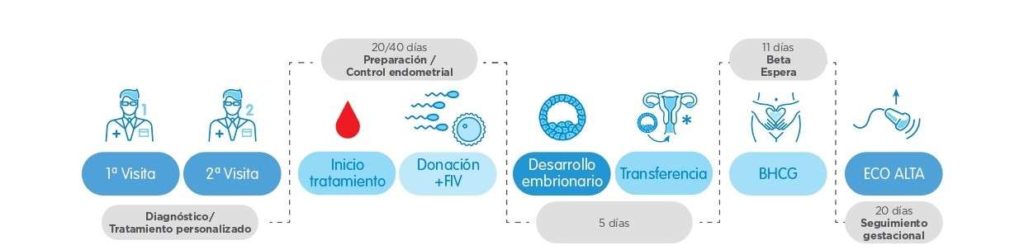
In egg donation treatments, both the donor and the woman receiving the egg must undergo a preparation treatment. Obviously during this process the two women do not know each other, since egg donation is an anonymous treatment. Next, we are going to summarize in a simple way what egg donation consists of:
- First visit: a specialist diagnoses the patient or the couple, analyzing medical history and through a gynecological study, in addition to a semen analysis in those cases in which there is a male.
- Donor assignment: During the egg donation process and subsequent donor assignment, IVI uses Perfect Match 360 technologyor.
- Patient stimulation: In our IVI laboratories the fertilization of the ovum is carried out, at the same time that the patient begins the preparation treatment to receive the embryo.
- Transfer of the best embryo
- Pregnancy test 11 days after the transfer.

Doubts about egg donation
Many of the patients who recur or consider using egg donation share concerns about whether their baby will resemble them. For this reason, at IVI we have developed Perfect Match 360 technologyor that analyzes aspects such as ethnicity, hair or eye color, height and blood group, among others. In addition, a facial similarity study is carried out – valued from 1 to 100 – and a genetic analysis, capable of detecting more than 600 diseases. With the development of this program we want to reassure our patients, putting at their disposal a technology that gives them security about the resemblance, physical and biometric, that they will share with their future child.
In addition, thanks to a study of the IVI Foundation we know that the Epigenetics it also influences the cases in which a mother becomes pregnant through egg donation. Thanks to this discovery, many women decide to resort to egg donation, overcoming some of the doubts related to the bond they will share with their future baby. Through this study on Epigenetics We know that during pregnancy there is a relationship between the uterus and the embryo. In this way, the mother exerts an influence that will determine fundamental aspects of the future baby, leading to physical similarities.
Thanks to this information, women or couples who have to resort to egg donation have an easier time managing the possible genetic grief that these patients suffer when they know they have difficulties in having a child. Despite having to need an egg donation, from the moment the patient becomes pregnant, a bond is created with her future child, initiating the bond that will unite them in the future, along with the rest of the family.
More and more women are resorting to egg donation, such as Noelia, a patient from IVI Alicante who wanted to tell us about her experience as a mother, by egg donation, of two twins


