


Probably many of you know the relationship between progesterone Y pregnancy, as well as the importance of this hormone before and during pregnancy. On IVI We go one step further with the finding of a relationship between blood progesterone levels and the success rates of assisted reproduction treatments.
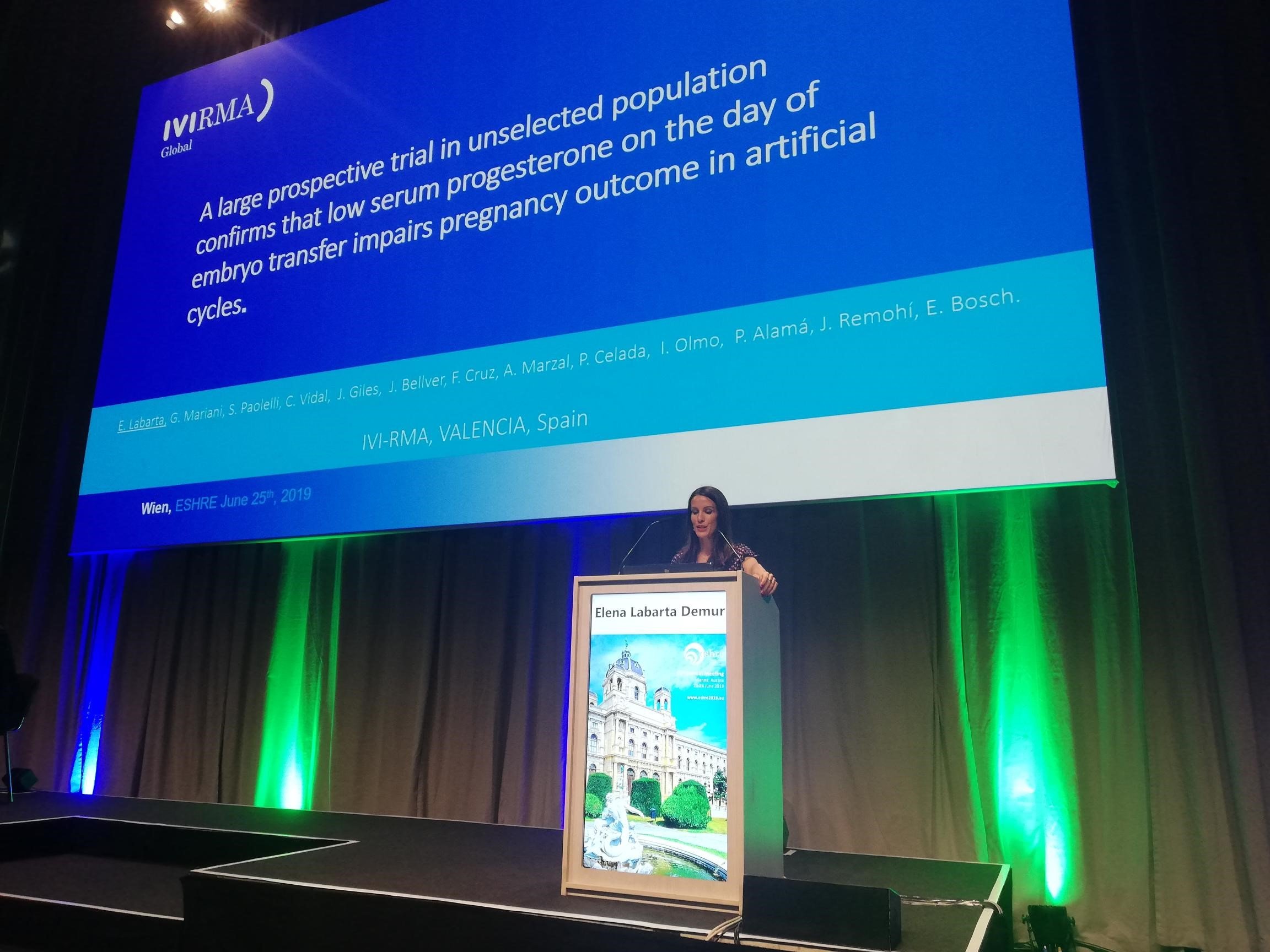
This conclusion is reflected in the study “A large prospective trial in unselected population confirms that low serum progesterone on the day of embryo transfer impairs pregnancy outcome in artificial cycles”, which was presented this afternoon at the 35th edition of the ESHRE (Society Human Reproduction and Embryology Conference), held this year in Vienna.
The doctor Elena Labarta, a gynecologist at IVI Valencia, has been in charge of presenting this work: “During the last 3 years, we have investigated the impact of the value of progesterone measured in blood on the day of embryo transfer on pregnancy rates in pregnancy cycles. artificial endometrial preparation. Until now, and based on previous studies carried out by other groups, it was thought that this measurement was not useful, since it was not capable of reflecting the action that progesterone was exerting at the local uterine level; and that, on the other hand, the dose of progesterone administered was more than enough to meet the needs of any patient. However, our findings have challenged this dogma and have shown that progesterone blood levels are associated with pregnancy outcome. We have carried out the first two prospective studies in this regard, which together include almost a total of 1,400 patients, thus being able to assert that there is a progesterone value below which evolutionary pregnancy rates can fall as much as 20%, which is a drastic decrease in the success rates of reproductive treatments, ”says Dr. Labarta.
The data presented at this annual meeting show the cut-off point for the progesterone level below which a significant worsening of the results is observed, which shows how the absorption of vaginal progesterone varies between patients, thus influencing the results achieved.
The research has a sample of about 1,200 patients and has generated great interest among the scientific community, its author, Dr. Labarta, being cited to speak about it in various forums and conferences around the world.
This work has its precedent in 2017, when Dr. Labarta’s research team published a first prospective study that pioneered the existence of a threshold for serum progesterone levels on the day of embryo transfer below of which term gestation decreased significantly.
“These findings have aroused our greatest interest and we are carrying out several lines of research. On the one hand, we have seen that the progesterone level predicts the outcome not only if it is measured on the day of embryo transfer, but also throughout the entire luteal phase (from the day the embryo is implanted to the day the embryo is implanted). the pregnancy test is performed). On the other, we are finding a way to rescue cases that present a suboptimal progesterone value and the results are very encouraging, since we have seen that the situation can be reversed if it is detected in time. An important finding that continues to help us in our continuous search for the best reproductive results ”, adds Dr. Labarta.
Exporting science to the largest European RA congress
ESHRE is the largest European congress on assisted reproduction, a meeting where the best professionals in the reproductive sector meet to shape the future of reproductive medicine.
In this edition, and as a sample of the constant research work carried out by IVI professionals, we have a total of 49 accepted papers, 14 of them oral and 31 posters, to which are added 4 invited papers by the ESHRE scientific committee for their scientific interest.
One of them is that of Dra. Labarta, followed by the works of the doctor Ernest Bosch, medical director of IVI Valencia, and the doctor Nicolas Garrido, director of the IVI Foundation.
Dr. Bosch has been the only Spanish member of the team that has defined the ESHRE guidelines regarding ovarian stimulation, a study carried out over the last two years.
For his part, Dr. Garrido exposes the techniques and criteria when it comes to intelligently selecting the most suitable sperm from millions, a fundamental process to achieve reproductive success.
Finally, the fourth invited session refers to the ESHRE recommendations for follicular puncture, a study in which the doctor has taken part. Roberto Matorras, gynecologist of IVI Bilbao.


