


These days the 77th edition of the Congress of the American Society for Reproductive Medicine (ASRM). It is one of the largest meetings, worldwide, on Assisted Reproduction. On this occasion, for the second year in a row, the event took place virtually to preserve the health of all attendees. Among them, the best researchers and specialists in the sector, gathered to share the latest news in the field of Assisted Reproduction. On this occasion, from IVI we have presented various works focused on assisted reproduction safety.
IVI at the 77th ASRM congress
On this occasion, from IVI we have presented about 70 works. All of them with the aim of offering our patients the greatest security and all the guarantees that are in our power, to return the trust they place in us.
“There are many lines of research that are part of our daily work, always under the premise of offering the best results to our patients and making their experience as bearable as possible. Getting your baby in the shortest time and with the best guarantees, taking care of every step of your process, is our priority. Our firm commitment to research and participation in leading conferences like this help us to continue leading this field in constant evolution “, explains the Dr. Nicolás Garrido, director of the IVI Foundation.
PGT-A and the work of the embryologist: keys to successful treatment
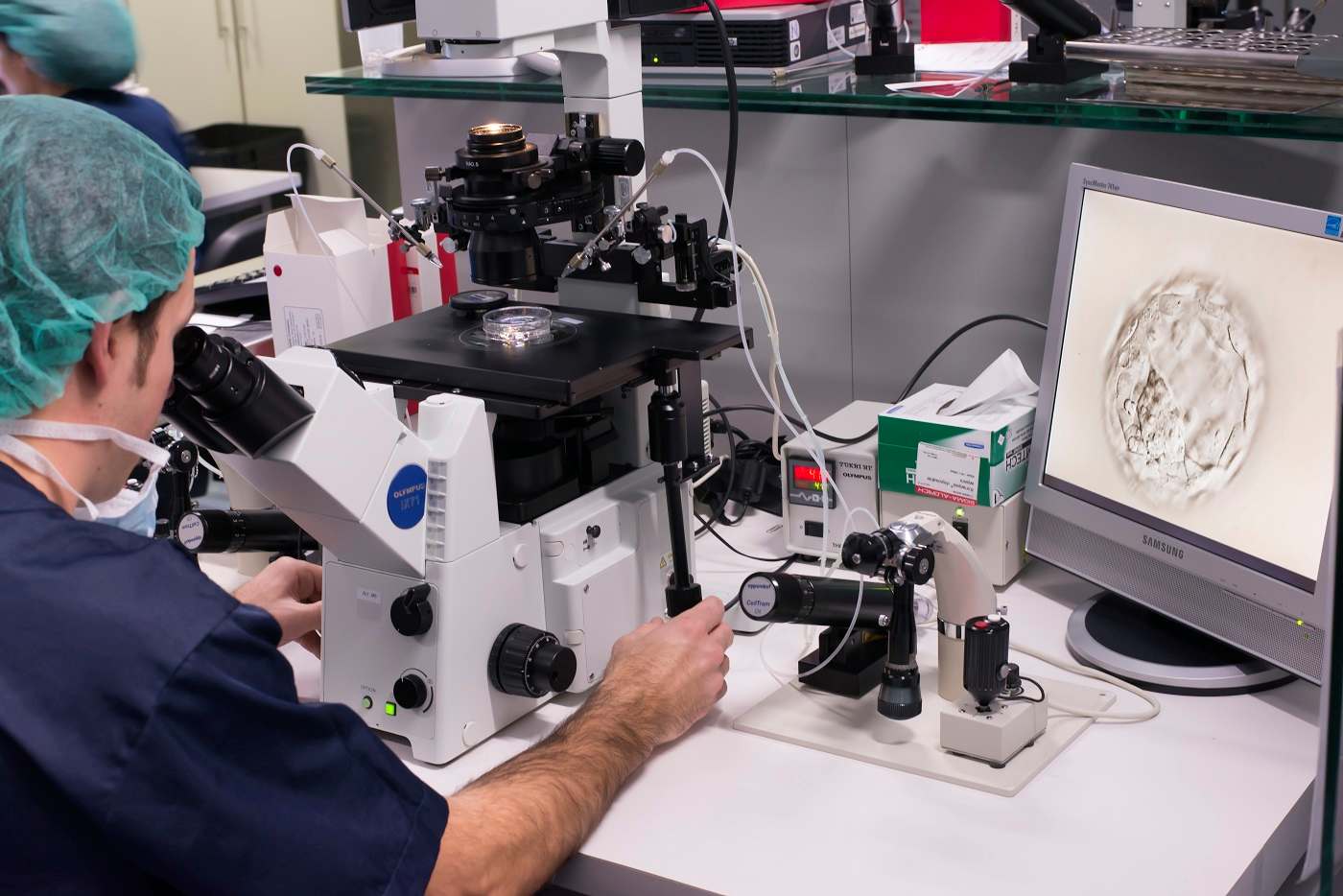
When approaching an assisted reproductive process, the role of the embryologist is key to its future success. And it is that, your criterion plays a fundamental role when selecting the best embryo that, later, will be transferred. In this sense, to date it has not yet been studied whether the morphological classification systems of embryos or other subjective strategies used by embryologists help in the selection of euploid embryos –those morphologically normal– with greater probability than aneuploid ones –those that They present an imbalance in the chromosomal endowment.
At IVI we are aware of this reality, which is why our researchers have analyzed the preferential selection of euploid embryos, by the morphological classification systems used in the laboratory.
“Out of a total of 156 single embryo transfers (SET), 129 were euploids, selected by embryologists blinded to the result of the embryo biopsy and subsequent PGT-A (preimplantation genetic test performed on the embryo) to determine the type of embryo. This shows the high training of embryologists to select euploid embryos to be transferred to the maternal uterus, based on the morphological classification “adds Dr. Garrido.
Finding the best embryo: the great challenge
Along the same lines, we have a second work presented in this edition of the ASRM, focused on understanding chromosomal errors in human embryos. Thus, this will allow us to know how these anomalies influence the interpretation of the results of the PGT-A performed on the embryo.
“An initial euploid or aneuploid result reconfirms in the rest of the embryo in almost all cases, demonstrating how meiotic errors –which take place during cell division– are manifested in the entire embryo. Thus, the observed discordance rate of 2% is consistent with the mosaic rate in the general population, so the combination of a reliable analytical platform and new advances in understanding the biology of embryonic errors should enhance confidence. in the results of the PGT-A “adds Dr. Garrido.
It is safe to undergo reproductive treatment after COVID-19
One issue that remains topical is COVID-19. Aware of this, in the 77th edition of the ASRM from IVI we have presented an investigation in this regard. Specifically, these are the results observed in patients who have resorted to reproductive medicine once the Coronavirus infection has been overcome.
“The truth is that, in an infertile population, a recent history of diagnosis of COVID-19 does not show a negative impact on the pregnancy outcome compared to a control population, although it is necessary to expand the study to a larger sample . This helps us reassure patients who wonder about the safety of reproductive treatments against COVID-19, urging them not to delay their processes once they have recovered from the disease “, concludes Dr. Nicolás Garrido.


