


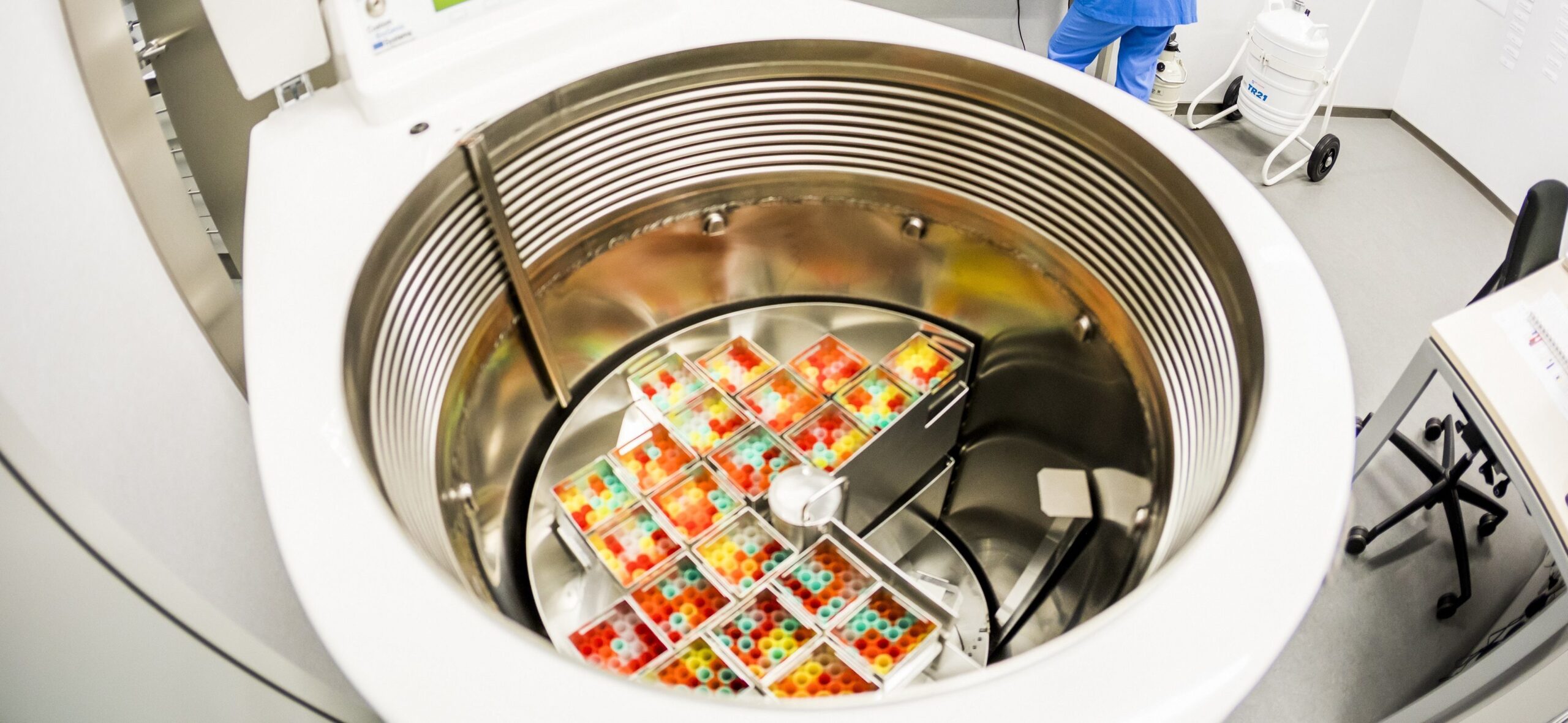
Today many of you (if not the vast majority) will be familiar with the term “vitrification”, Or second women’s revolution, as some call this important scientific advance.
And it is that after the contraceptive pill, oocyte vitrification has allowed women to gain a necessary and historically claimed right: the freedom to decide.
When and how to be a mother is an option that currently every woman has at her own discretion and choice. This reality, 20 years ago more utopian than feasible, has been made possible by the aforementioned vitrification technique. Its success has marked the future of the field of assisted reproduction and today we have the pleasure of sharing with you something that makes us especially excited:
A pioneering work worldwide on vitrification, led by one of our specialists, the Dr. Ana Cobo, has been recognized by the American Society for Reproductive Medicine (ASRM) as one of the 25 best in the 75 years of history of this society, one of the most important in the world.
Dr. Cobo is the director of the Cryobiology Unit of IVI Valencia, and by many colleagues in the profession known as “mother of vitrification”, due to her relevant findings regarding this technique.
Vitrification: a revolution for women
Vitrification has evolved and with it the results achieved, which today are so encouraging that the preservation of women’s eggs is emerging as a booming alternative with great efficiency in its subsequent use in reproductive treatments.
The work recognized by the ASRM, entitled “Comparison of concomitant outcome achieved with fresh and cryopreserved donor oocytes vitrified by the Cryotop method”, promoted a little more than a decade ago the generalized use of ovule vitrification in daily clinical practice, thus becoming in a pioneering study in the world regarding the clinical application of the method.
“We took oocytes from the same donor, vitrified half and thawed them after one hour, while the other half remained in the incubator. Once the oocytes have been devitrified, we fertilize them together with the fresh ones, with the same semen and at the same time. This allowed us to evaluate the development of embryos generated from fresh and vitrified oocytes under the same conditions, comparing rates of fertilization, early division and development to blastocyst. And it was a pleasant surprise to see that the results obtained were similar in terms of these 3 parameters, which prompted us to start vitrifying donor oocytes, since we knew that they would survive and that the resulting embryos had the same implantation potential. and give rise to evolutionary gestations than embryos from fresh oocytes ”, explains Dr. Cobo.
Thanks to this research, the possibility of obtaining viable embryos with vitrified oocytes was demonstrated, a method that has been replicated in later years by hundreds of centers and professionals in the field.
“This has meant that today we have consistent and efficient cryopreservation programs from which many patients can benefit, with very different indications: patients in reproductive treatment with low ovarian response, as an alternative to avoid the risk of ovarian hyperstimulation, women who decide preserve their fertility, whether for medical, oncological reasons or by choice, and even patients with endometriosis, a disease that can compromise their future fertility, in which we have recently demonstrated the encouraging results of oocyte vitrification ”, adds Dr. Cobo.
A technique widely used in donation programs
The preservation of oocytes in banks is today a standard procedure in donation programs, a process that is constantly being improved and that has made it possible to greatly reduce, and even eliminate in some cases, long waiting lists.
However, although this technique and its efficiency paint a very optimistic outlook for motherhood, there are limiting factors that we must not lose sight of, such as age and the number of oocytes.
“The truth is that, currently, the cryopreservation of female gametes is an essential part of assisted reproduction, given the high success rates achieved thanks to the optimization of this technique, but it is important to encourage women and make them aware of the need to vitrify their eggs before the age of 35, since from this age their fertility begins to decline and with it the chances of reproductive success, ”says Dr. Cobo.
This mention rewards the tireless work of a multidisciplinary team of specialists who investigate to achieve the best results to fulfill the desire of all women and couples to be parents.
“Being among the 25 best works of the ASRM is an honor for me, a milestone, and an enormous satisfaction, not only on a personal level, but also for the work done by the team of high-level professionals that we have. The dedication of each one of them and their involvement with patients, as well as the incessant research work they carry out allows us to apply findings like this on a large scale, something basic for the validation of any technique and any strategy at a clinical level ”, concludes the Dr. Cobo.


