


Artificial Intelligence in embryo selection: a reality thanks to IVI
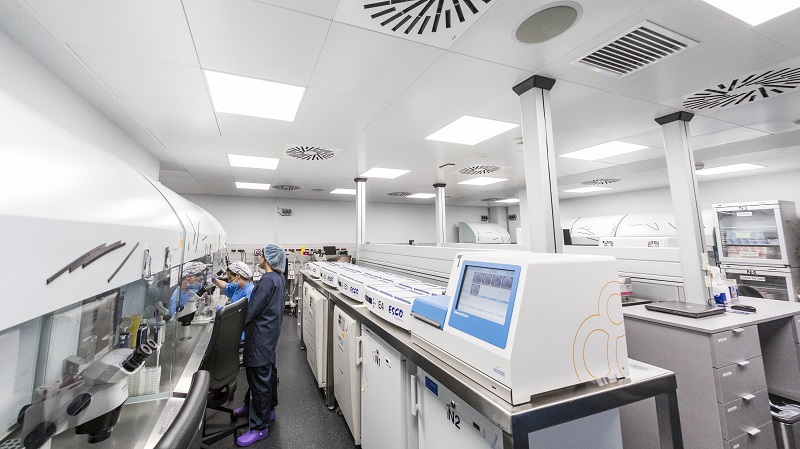
- Artificial Intelligence has made it possible to create the KIDScoreD5 system, which analyzes and classifies embryos automatically, increasing the probability of gestation and pregnancy
- IVI has carried out the most extensive study to date, which has allowed it to demonstrate this clinical revolution in embryo selection through Artificial Intelligence
- This study on Artificial Intelligence and KIDScoreD5 is presented on the occasion of the 36th Congress of the European Society for Human Reproduction and Embryology (ESHRE)
While it is true that the creation of the KIDScoreD5 system is a true revolution in embryo selection, IVI’s relationship with Artificial Intelligence to make improvements in this field goes a long way. And it is that from IVI we participate in the development of EmbryoScope, an incubator with time-lapse technology that was born with the aim of helping in the development of automatic embryo selection. Now we present a new advance from the EmbryoScope: an even newer software, the KIDScoreD5, what allows automatic selection and classification of embryos.
To achieve the development of this advanced software, IVI has carried out a study during the last three years, with the largest casuistry in scientific history to date, with the analysis of 20,000 embryos and 3,000 patients. Through this study, IVI has revolutionized the embryology sector, allowing to have a universal, standardized and automatic embryonic selection.
He tells us about the KIDScoreD5 system Dr. Marcos Meseguer, scientific supervisor of IVI Valencia and main researcher of this study: “the KIDScoreD5 system automatically classifies embryos using Artificial Intelligence, detects and evaluates all the steps of the embryo’s development and also classifies its morphology”.
The KIDScoreD5 system analyzes embryos automatically and classifies them from one to ten, based on their quality and morphology. Automated embryo selection, compared to manual, is more accurateTherefore, the probability of an evolutionary pregnancy is directly related to the score percentage and, therefore, the patient has a greater probability of success.
- In the field of Assisted reproduction, this is the first time that automated embryo analysis has been shown to have clinical utility
- The largest casuistry in the world so far, which is the greatest example and the guarantee of the reliability of the system
- More information about each embryo and, therefore, greater chances of choosing the best one to transfer
- Ability to select and chromosomally categorize the best embryos, which leads to an increase in gestation and pregnancy rates, and reduces the chances of chromosomal abnormalities
- Absolutely non-invasive technique that improves all current selection methods
As he points out Dr. Meseguer: “We have seen that the KIDScoreD5 system, by means of an assessment, distinguishes between those embryos with the highest probability of being chromosomally normal (euploid) and those that are not (aneuploid). Based on the score that the system gives to each embryo, we know the probability of its pregnancy and the possibility of having a healthy baby at home.”.


