



If there is something that concerns us all, patients and medical professionals, it is safety. It has been a maxim since we resumed the activity and We have made IVI clinics, laboratories and assisted reproduction treatments safe spaces, where the only thing that is incubated is life and dreams.
And, although the SARS COV2 virus has surprised us all, IVI laboratories have already been working with infectious agents for years, which has allowed us to adapt them very easily to the new situation.
We wanted it to be the Dra. Mª José de los Santos, director of IVI Valencia’s IVF laboratory, which explain to us in this post, how to work in an IVI laboratory with infectious agents.
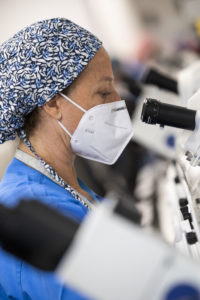
Undoubtedly, the pandemic situation generated by the appearance of a new infectious agent called SARS COV2 with such serious clinical implications for health has created a situation of sustained alarm over time, confusion and uncertainty in our society, also affecting the field of Assisted Human Reproduction (RHA).
However, today I want to share with you a series of information related to control and work with Infectious agents within the In Vitro Fertilization Laboratory and which I hope will contribute to shedding a glimmer of confidence and tranquility in those couples who are in the middle of an assisted reproduction process or are planning to put yourself in the hands of Reproduction specialists.
IVI labs are safe
The first thing I would like to tell you is that in IVF laboratories we are prepared and we know how to work and handle potentially infectious samples avoiding cross contamination between samples from different patients or infection from embryologists. This is also part of our training together with the acquisition of knowledge of the biology of reproduction.
In fact, we have learned a lot from the accumulated experience with the management of other infectious agents such as the human immunodeficiency virus (HIV) or liver disease C, in patients with detectable viral load and who needed to resort to RHA techniques. Nowadays its handling in laboratories is considered within routine procedures.
For example, HIV-positive men can use their semen samples free of virus, avoiding the risks of transmission to the mother and children by combining techniques of sperm washing and detection of the virus with techniques already well known to all. how are the PCR.
COVID19 and assisted reproduction
It should be noted that today, and unlike other viruses like the ones I just mentioned, there is no evidence of the presence of SARS COV-2 in oocytes or semen of patients who have not gotten sick from Covid-19. In the case of spermatozoa, the presence of the virus has only been seen in seriously ill patients who have required hospitalization.
On the other hand, regarding the handling of the samples, comment on several important technical aspects,
- The laboratories are provided with specialized equipment and accessory material that prevent the spread of those already known aerosol sprays when the samples are processed.
- The equipment is always kept sanitized after use.
- The processing to which the samples are subjected, both oocytes, sperm or embryos, involves extensive washing and this we know effectively eliminates the presence of infectious agents in gametes and embryos.
- The IVF laboratories are clean rooms, this means that there is an air quality control. This is achieved with air handling units equipped with HEPA filters and other types of filters that prevent the entry of environmental pollutants and that allow to maintain high purity in the laboratory environment, which helps to reduce the spread of Infectious agents in the work environment. This situation, together with the proper use of masks, hats, gloves in the processes that require it and frequent hand washing reduces the presence of airborne particles that can carry infectious agents.
I hope that this information has been useful, interesting, and that it has contributed to being a little more aware of less known aspects of Assisted Human Reproduction but just as important to minimize the risk of infection and maintain an excellent level of care and quality.
Dra. Mª José de los Santos
IVF laboratory director
IVI Valencia


