


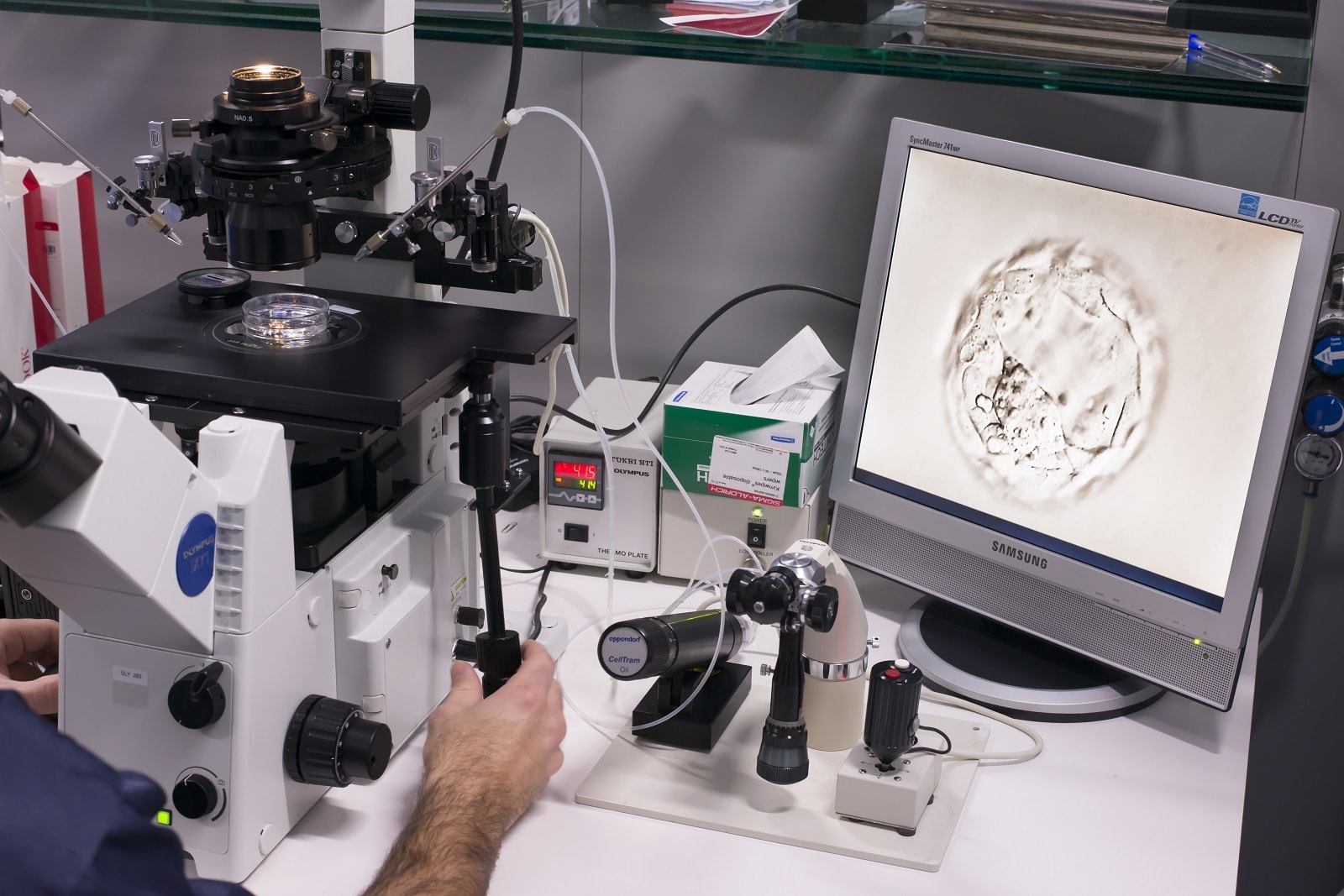
Today ends the 75th Congress of the American Society for Assisted Reproduction (ASRM), a meeting in which hundreds of professionals in the reproductive field have gathered to share the latest advances in reproductive medicine.
Among them, we would like to share with you two of the studies that we have presented at this congress and that bring us closer to a goal we have been pursuing for nearly 30 years: achieving full-term pregnancies with healthy babies.
In this sense, the latest research on the probabilities of pregnancy with obtaining normal embryos or the guarantees associated with the application of preimplantation genetic tests such as PGT-A provide encouraging results to meet our goal: Offer patients the best possible security and confidence on your path to parenthood.
Today we know, thanks to the work led by Dr. Paul Pirtea, who has led his research in RMA, that women and couples who obtain 3 normal embryos in their IVF treatment have a 95% chance of pregnancy.
“These findings show something that we had been believing for years, and that is that aneuploid or chromosomally abnormal embryos that present chromosomal alterations are the main cause of recurrent implantation failure and, therefore, of failures when it comes to achieving a full-term pregnancy. . The improvements in IVF rates thanks to preimplantation tests such as PGT-A make it possible to fine-tune embryo selection, reducing multiple pregnancies and at the same time increasing the chances of implantation, full-term pregnancy and a healthy live newborn ”, comments the Dr. Juan Antonio García Velasco, director of IVI Madrid.
Test like PGT-A, the ideal option to achieve viable pregnancies
Another of the papers presented at this congress, led by Dr. Ashley Tiegs, IVI fellow in New Jersey, refers to the use of preimplantation genetic tests, such as PGT-A, which help to rigorously identify embryos with abnormalities that in most cases will lead to abortions or implantation failures.
The study shows how of the 285 embryo transfers, all of them analyzed using the PGT-A preimplantation test for aneuploidy detection, of the 50 biopsied embryos with abnormality results, none of them resulted in a full-term pregnancy.
“Added to this is the fact that implantation rates were equivalent for biopsied and non-biopsied embryos, which indicates that embryo biopsy does not harm embryos or negatively influence embryo implantation rates, a fact that has historically aroused constant concern among the scientific community and the patients themselves ”, explains Dr. García Velasco.
The reliability of this work is based on the fact that it is a blinded study, that is, neither the doctors nor the women who took part in the study knew the result of the test performed on the embryos before their transfer.
The research is still in a very early stage, but it is expected to be able to expand the sample of embryos to be analyzed, thus becoming the only large-scale research on the predictive value of aneuploidy diagnosis carried out to date. This will help shed light on the scientific debate about the reliability of genetic testing.
“Patients must continue to rely on preimplantation tests like PGT-A, and be assured that when an embryo is labeled abnormal and not transferred, that embryo is not mistakenly discarded. The PGT-A provides accurate and reliable data, saving patients time, money, and emotional stress, offering them confidence in the transfer of normal embryos, with a high probability of giving rise to a healthy baby ”, concludes Dr. Dr. García Velasco.
The PGT-A is one of the tests that have caused the most improvements in IVF, consequently increasing the single embryo transfer (SET) rates and notably improving their results. The SET, for its part, has made possible a significant reduction in the risks associated with multiple pregnancies and births, thus allowing the birth weights to be equated between IVF babies and those conceived naturally.
IVI figures in the ASRM
The ASRM is the largest American congress on assisted reproduction that welcomes, every year, the most important specialists in assisted reproduction to shape the future of the sector.
In this edition, IVI has presented 66 papers:
- 24 selected for oral communication. Or what is the same, 9% of the total oral presentations of the ASRM have been from IVI
- 33 posters (representing 4% of the total posters exhibited)
- 3 scientists-in-training awards
- 1 presentation in the general award nominees section of the congress
- 1 video
We keep investigating!


