


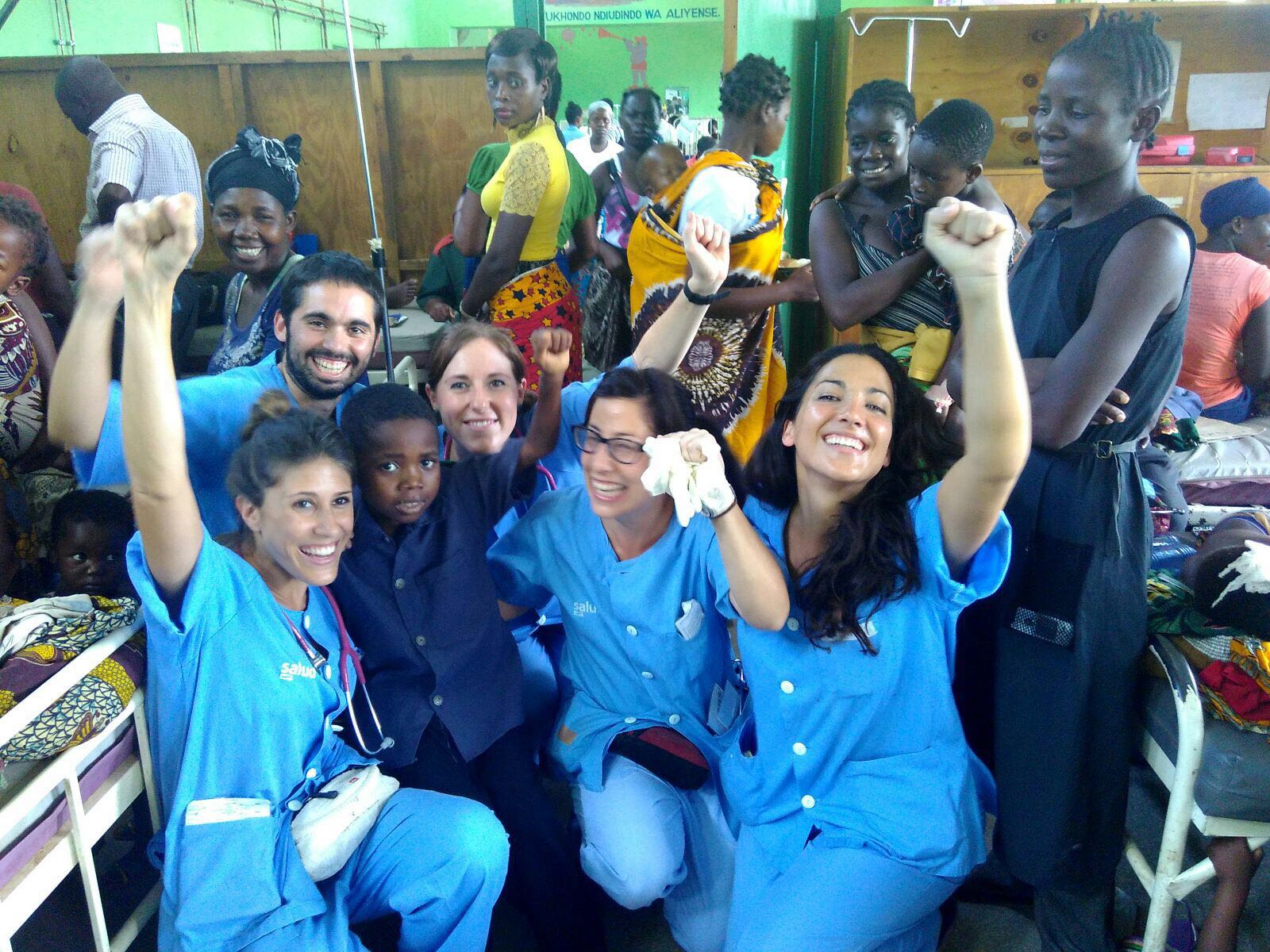
Last week we shared with you the precious social work carried out by ASACO and we announced another NGO with which this year it shares the collection of the project «Teaming»Carried out by IVI within its plan of sustainability.
Today is the turn to tell you about the wonderful social action of Malawi-Health by mouth of its President, Mª Carmen Ferrer:
- How was your association born?
The origin is a bit special.
Since 2005, several professionals from the Aragonese Health Service (SALUD), financed by this organization as public health workers, have carried out cooperation activities in Malawi providing training and equipment to small hospitals, responding to the request for help from Spanish missionaries. Starting in 2008, this support was transferred to the large public hospital in central Malawi, the Kamuzu Central Hospital.
In 2011, with the economic crisis, SALUD support was eliminated, at a time when Malawi, a country highly dependent on international support, was on the brink of collapse. There are crises and crises, and in Malawi there was a time when there was even a shortage of fuel, leading to a terrible shortage, especially tragic in hospitals.
The professionals who had worked there until then, considered that it was by no means the time to abandon our support, so we continued to travel to Malawi on our own and promoting donations to send the most essential supplies, especially antibiotics and analgesics.
We created an association, which currently has almost 200 members, and above all members, and we maintained our collaboration in the worst moments. In recent years we have once again received some financial assistance, especially from the Zaragoza City Council, but with or without assistance we are in a position to continue working in Malawi as long as we are needed.
- Mission, vision and values
Mission:
Promote the strengthening of health systems in developing countries, especially in Malawi, which is our current field of work, and working specifically for the reduction of infant mortality in that country. Our goal is to bring the best aspects of our healthcare system to the Malawian public healthcare system.
View:
Realize the right to health of especially vulnerable groups, such as women and children from disadvantaged countries.
Values:
The values that we want to promote are those of our health system, which guarantees the right to health of all citizens without distinction.
They assume the assumption of the obligation of preventive actions, treatment and rehabilitation of citizens from the following principles:
– Universality
– Equity and gratuity
– Accessibility
– Solidarity and respect for human rights
- What is the most rewarding and enriching thing about your work?
Perhaps to answer that question it is useful to explain the contents of our program.
Although we knew from the beginning that the famous motto “don’t give the fish, teach how to fish” was unquestionable, developing that was more complicated.
We were considering improvements in a hospital with a reference population of 6 million inhabitants, with times when there could be 100 daily admissions of children, suffering from very serious diseases, and a negligible and disorganized staff. We immediately saw that going to give courses of a few days was inappropriate, so we reformulated our proposal, although it required greater effort, and we proposed that our collaboration would be done from our daily work, side by side, with the professionals there, entering fully in their difficulties and proposing improvements from a direct knowledge of the harsh situations they live.
This is what makes our work more rewarding, that we do not place ourselves from a position of theoretical or technical superiority, which sometimes, in addition, we do not have (they have been treating malaria, AIDS and malnutrition all their lives), but we are with them bringing children forward and proposing other work models in which the daily life of death can be compatible with an empathic, optimistic and proactive attitude at work with professionals and with children.
We challenge ourselves, we bring many children forward, and we live experiences that make us feel much more indispensable than in our country.
- How would you encourage people to join this project, either financially or more actively in the NGO?
Our program is modest, we consider small to be beautiful and we do not have the aspirations of large cooperation organizations, whose work is otherwise valuable.
But we do effective work, we all have our livelihood in Spain, our work in relation to Malawi is voluntary, we are very good health professionals, but we do not have organization or management expenses, which are assumed from a solidarity volunteer service.
So every euro that is contributed is fully materialized at the destination.
Our volunteers manage the fundraising campaigns, the website, the project design, the procurement of supplies, the bureaucracy involved in sending professionals to Malawi and their logistical support on the ground, so there is work for everyone , but especially for nurses and pediatricians.
- What programs do you think should be implemented in our country or worldwide to promote social projects like yours? And to avoid situations of lack of resources such as those experienced in Malawi?
Our care is basically health care due to our origin, but if we want to achieve a more just and balanced world, we cannot choose, given the existence of very poor countries that currently, whether they want to or not, are spectators of our standard of living and sometimes of our waste , by putting up walls and borders, we will all be happier and safer if we promote sustainable development in those countries, and that is education, agriculture, environmental protection, health … we have no doubts, working in that direction is not generosity, it is also our own interest.
- What does it mean at the level of awareness that companies like IVI involve their professionals in choosing the social projects to which the aid is intended?
It is wonderful, it is to introduce solidarity in society. People avoid or reduce aid because they distrust, sometimes with good reason, the destination of their contributions to aid organizations. Having the possibility to investigate, find out and choose, surely makes it easier for workers to be more favorable to aid.
- At IVI we work daily for health, women and children. What does it mean at the development level to support projects like Malawi-Salud working in the aforementioned areas?
Our program goes precisely in that sense, a couple of figures will suffice, between December 1, 2016 and December 31, 2017, 743 boys and girls died after being admitted to the hospital where we work … that means a mortality of 3 , 5% of the income. Since 2012, when we stepped up our support, mortality has dropped from 9% to 3.5%. These are still terrifying numbers, but they add value to our work.
The reduction of infant mortality not only affects children, the hardest moments of our work are seeing mothers devastated by the death of children, deaths in many cases avoidable, more than two a day. And that reduction will also affect the family structure in the medium term, which is still there to have many children, knowing that some will die.
The reduction of the birth rate, a priority objective in Malawi, is multifactorial, but we will do our bit with the reduction of mortality.
- In which projects is the money offered by IVI employees going to materialize?
Our basic project is the one that we have described in some way in the previous answers, we send pediatric teams to the Kamuzu central Hospital in Lilongwe, Malawi, in a very efficient way, that is, with a very favorable cost-benefit ratio, since we send MIR of pediatrics on external rotations, who assume all their expenses, and nurses whose travel and stay is financially supported, since they temporarily resign from their work in Spain. We detect needs for equipment and supplies and we meet them to the best of our ability.
We stay in the field 8 months a year, the months with the highest incidence of malaria and malnutrition (the rainy season).
With this basic program, we open other possibilities every year, we have started hydrocephalus surgery programs, we are going to start this Christmas a program to improve renutrition, and we will rely on your contribution to open another possibility, that of improving care centers primary. Vaccinations and family planning save more lives than hospital care, our next project will be the rehabilitation of a health center in a very poor suburb of Lilongwe, Chinsapo, so that it can offer these benefits in conditions of dignity that now does not have.
Just insisting on our gratitude, small projects are also important and sometimes they deal with the things they do with more detail and closeness … As Eduardo Galeano says: «Many small people, in small places, doing small things, can change the world».


