


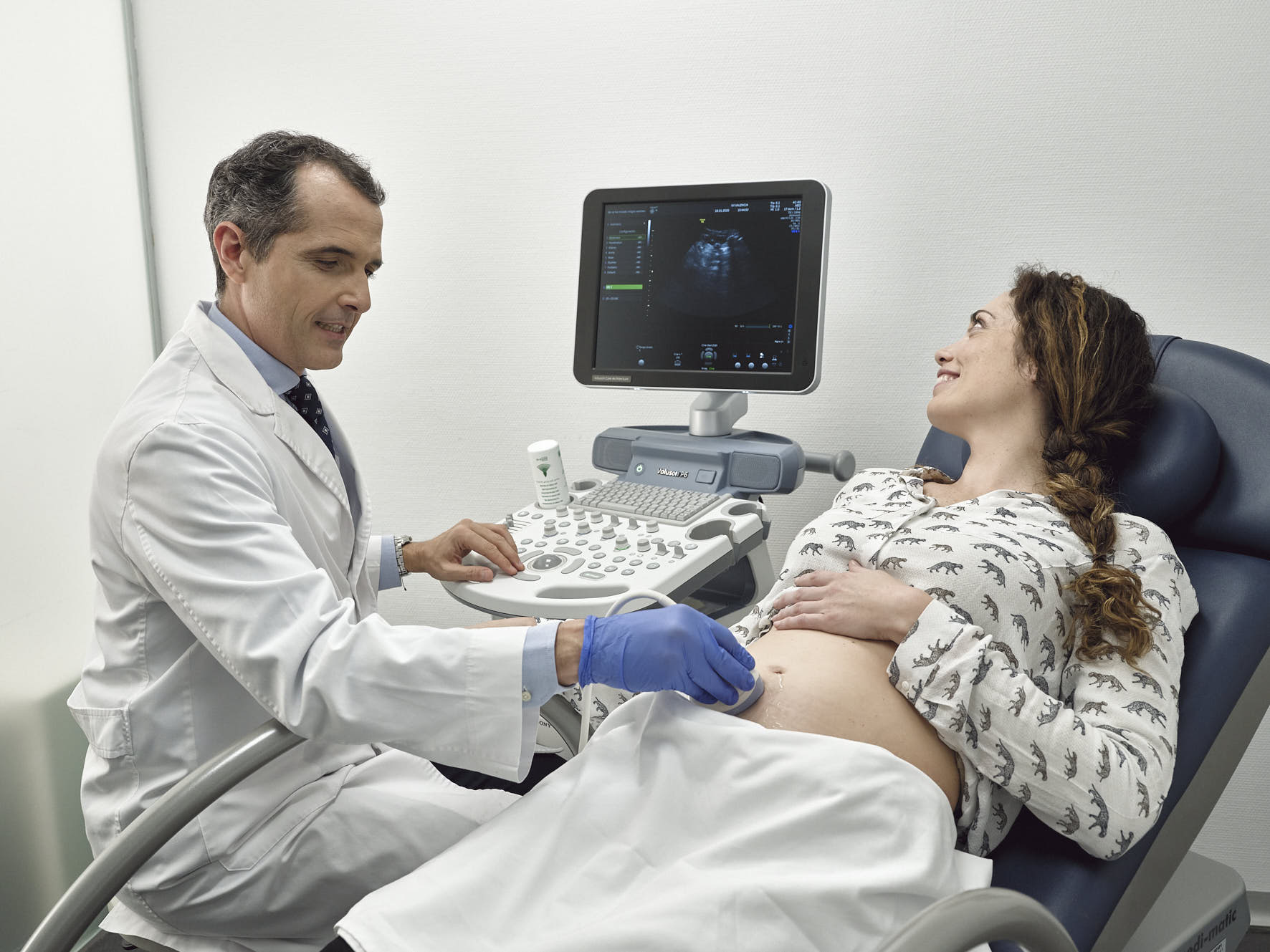
The road to getting pregnant is so long and complicated in some cases, that when it is achieved you want to be sure that everything is going well, that it will continue even better and that the baby is healthy. For this reason, we have asked Dr. Ángel Grañeras, the doctor in charge of the Maternal-Fetal Medicine Unit of IVI Madrid, to tell us how the maternal-fetal ultrasounds that are performed in pregnancies achieved through assisted reproduction treatments.
At IVI we have maternal fetal units to carry out this follow-up once you have achieved pregnancy. Do not hesitate to ask for her at your IVI clinic.

Ultrasound follow-up in assisted reproductive pregnancies
I would like to start by saying that globally, ultrasound follow-up in pregnancies after assisted reproduction will not differ from the management of a pregnancy achieved spontaneously, you are not strange creatures, but they will have some peculiarities that we must consider at the same time. time to carry out the study of the fetus.
First, we have to take into account why the pregnancy could not be achieved spontaneously, here there are many times factors of the female anatomy, such as the presence of fibroids or malformations of the uterus, among others, that we must bear in mind when performing the ultrasound examination and establish whether or not they will be able to influence and see that the pregnancy proceeds in a normal way, there is no greater risk that motivates it to fail.
We must also be aware of the age of the pregnant woman, many times over 35 or 40 years. This should not suppose, as we usually think, a greater problem in terms of the risk of abnormalities in the fetus, since techniques are carried out to avoid this, such as preimplantation diagnosis of the embryo or oocyte donation among others, but at the time to consider what the environment will be where the embryo will grow, such as the characteristics of the uterus and placenta, hormonal factors in the mother, such as the existence of diseases such as diabetes or thyroid problems, hypertension , etc. more frequent as our age increases.
And last but not least, it is the anxiety factor that often accompanies pregnancyWe have spent a lot of emotional resources up to here and we arrive with a degree of fragility that makes us much more vulnerable to any eventuality. If we take into account that it is in the echo where we are directly visualizing how the fetus is and how the pregnancy is going, it is important to know how to transmit it to the parents in the most reassuring way possible without missing the reality of the findings that we are seeing, our patients deserve that we pamper them when giving that information.
How are maternal-fetal ultrasounds in the first trimester
How are we going to structure our visits? We are going to do it in 4 controls that have in common globally seeing the normality of the fetus that we are carrying and its evolution over the weeks. In addition, each of them will look for different aspects that make them different from each other.
In a first echo, which we carried out on weeks 11 to 14, we are going to study 2 aspects, on the one hand the fetal anatomyAlthough the fetus is small, we must see that everything that has been formed is correct for these weeks. And secondly we are going to look for what we call ultrasound markers of chromosomal alteration of the 1st trimester, features of the echo that will tell us the risk that the fetus has a chromosomal problem, such as Down syndrome or Turner syndrome among others. With ultrasound we will reach 80-85% for these, if we add the combined screening of the 1st trimester, blood tests that are routinely requested in the early pregnancy analysis (weeks 9-12), and then we will have to combine with the eco, we reached 90% and there we would stay for most of these, although for some such as Patau syndrome we can reach higher percentages. At this time we can also offer, if we consider it appropriate, the study of fetal DNA in maternal blood, analysis of trophoblast cells that will give rise to the placenta, which are circulating in the mother’s blood and that allow us to achieve Percentages of diagnostic sensitivity for some pathologies such as Down’s Syndrome of 99.9%, although for others it will be the echo that will provide us with the most information. If in this echo we see a problem that makes us suspect the existence of a chromosomal abnormality, this is not worth it, and we will offer an invasive study, such as chorionic biopsy or amniocentesis, which has a risk of pregnancy loss, but will It is much more complete than fetal DNA and the benefit of the information that we are going to obtain justifies the risk that we will run, so we will only recommend it in these circumstances.
Ultrasound checks in the second trimester
From there we would go on to the ultrasound of the II trimester, weeks 20-22, which has different names like morphological ultrasound, prenatal diagnosis, etc. And that is the one that is going to provide us with quite detailed information about the anatomy of the fetus. We have to study everything that it allows us, following a scheme so as not to leave anything unexplored, from the structures of the Central Nervous System to the orientation of the feet, paying special attention to the echocardiography or study of the heart as it is a target organ where problems associated with any fetal disease are frequent. We also have to study what we call ovular adnexa, the placenta or amniotic fluid, as well as the length of the cervix or the circulation in the mother’s uterine arteries to see the risk of later complications. This is probably the most important echo for us because it is the first complete assessment that we can make of the fetus.
Before we went from this ultrasound to the one from week 32-34 where we did the last scan. Now this has changed, because on the one hand a lot of time passed between them, time in which we were not seeing how the function of the organs was developing as the fetus was growing, and we could not see if this growth phase rapid that appears in the second half of gestation was occurring adequately. So we planted ourselves in week 32 and if the fetus had a growth problem or a disorder of the function of organs such as the heart or kidneys, we already had little ability to maneuver. And on the other hand, there was still a long time left until the moment of delivery, and complications could appear mainly related to growth or vascularization, which gave us surprises at the time of delivery.
For this reason, an echo is introduced around week 28 to see that this function is performed correctly and coinciding with the beginning of the phase with the highest rate of fetal growth, to see that this occurs normally.
Ultrasound in the third trimester with a view to delivery
To end, the last echo is performed in weeks 35-36, where in addition to assessing the position with a view to delivery (It must be in cephalic, with the head down so that it is a normal delivery), as well as the anatomy as in all the controls, we must assess how the fetus is growing and related to this, how the contribution is coming from the mother to through the placenta by studying the circulation in a series of fetal vessels.
In all of them we must also assess aspects that are not always easy to quantify or reflect in the protocols and that depend more on the experience and the eye of the sonographer, such as the relationship between the size of the fetus and the cavity where it is hosted. This will depend on the volume of amniotic fluid or the thickness of the placenta, so we will speak of “sensation of a compressed fetus”, a term not shared by all sonographers and that in our experience often has a growth disorder at the end of pregnancy or a complication, such as a rise in blood pressure or pre-eclampsia, and that sometimes we can reverse before it is established, acting on drug treatment if you are already receiving or introducing it.
The most important in maternal-fetal ultrasound in RA pregnancies
In summary, we can say that the management is similar to a pregnancy obtained spontaneously, with a series of peculiarities that we must bear in mind and a different sensitivity and perception, avoiding falling into the routine of normal consultation, and giving value to aspects that are not always perceived by sonographers and that should allow us to anticipate adversity given the complexity of achieving our pregnancies.
Dr. Angel Grañeras
Physician Responsible for the Maternal-Fetal Unit
IVI Madrid Clinic


