


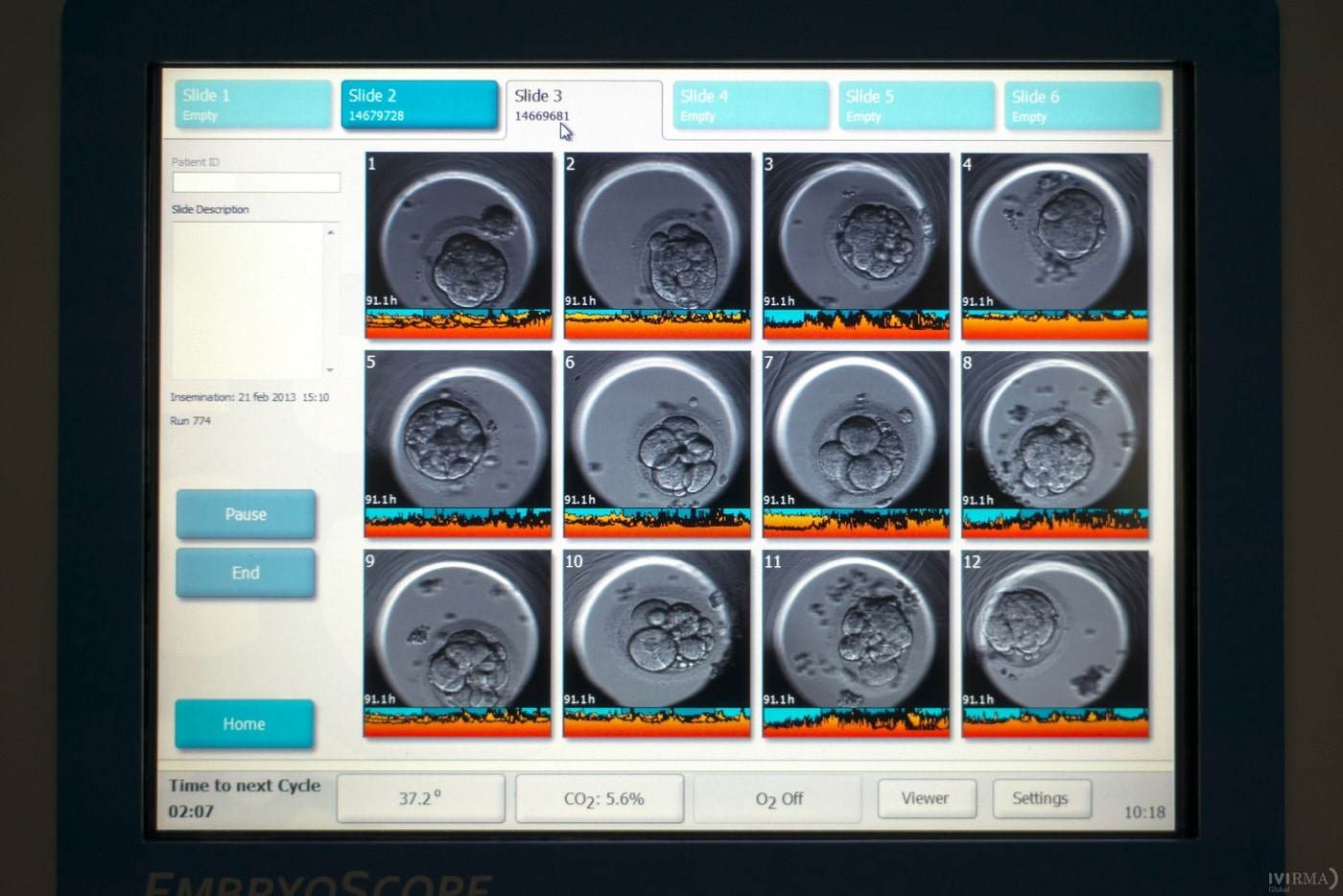
There are several occasions on which we have talked about Artificial Intelligence and its use in reproductive medicine. And it is that from IVI we have contributed, through various studies, to the development of this tool in the selection of embryos. Now, within the framework of the 38th Congress of the European Society of Human Reproduction and Embryology (ESHRE) we have introduced a new breakthrough.
The promising results of Artificial Intelligence
There are many current and future uses of Artificial Intelligence. It is a technology that is here to stay, in different fields: social, political, economic and even scientific. Artificial Intelligence has a privileged place in all of them, given the rate at which its multiple applications are growing.
In this context, we want to talk to you about the study “Artificial Intelligence (AI) based triage for preimplantation genetic testing (PGT); an AI model that detects novel features in the embryo associated with ploidy”. This has been presented in the current edition of the ESHRE, which is being held these days in Milan. This study has been led by the Doctor Marcos Meseguerembryologist and scientific supervisor of IVI Valencia.
“This is a pioneering study, since for the first time in the world we have developed and combined 5 independent modules that analyze characteristics of the embryo using computer vision. With this, an accuracy of 90% has been achieved in the prediction of chromosomally normal embryos. Being able to evaluate the potential for embryo implantation in this way allows us to improve the efficiency of a fundamental process in assisted reproduction, such as embryo culture and selection”explains Dr. Meseguer.
This is an unprecedented percentage of precision, close to that obtained by conventional study of the embryo, which is performed invasively. Through the application of Artificial Intelligence, the embryo can be studied, using complex algorithms, which would avoid having to manipulate it and extract cells. In addition, a high success rate is obtained in the selection of those viable embryos for subsequent transfer.
“The germ of this study responds to an unquestionable reality: embryonic development does not occur in the same way in euploid (chromosomally normal) and aneuploid (chromosomally abnormal) embryos. At this point, could Artificial Intelligence predict ploidy (number of chromosome sets in a cell)? The 5 modules that we have been able to analyze and combine show us that yes, it would be possible and reliable”comments Dr. Meseguer.
To carry out this work, 2,500 embryos have been analyzed, assuming the most important casuistry scientifically analyzed worldwide. The result has been an innovative technique in the field of embryology, non-invasive, universal, standardized and automatic that would improve all current embryo selection methods.
The 5 modules that have been studied
- Morphokinetic parameters. This module refers to the times in which the most important events in the development of the embryo occur. That is, when the embryo divides into cells until it reaches the blastocyst stage.
“By simply analyzing these parameters in the 2,500 embryos studied, we have been able to verify that, taking a euploid embryo as a reference, if another embryo arrives later than this one at an event, its probability of being aneuploid increases considerably”points out Dr. Meseguer. - Embryo morphology. When studying this parameter in an automated way, it has been observed that embryos with good morphology are more likely to be chromosomally normal. In itself, morphology has a predictive capacity for aneuploidy of 68%.
-
cell activity. In this module, the diameter of a cell is measured and all the diameters of the cells of the embryo at a specific moment of its development (from 2 to 8 cells) are added up.
“With this, some values are automatically calculated that are subsequently analyzed for 160 images, resulting in chromosomally abnormal or aneuploid embryos having a longer diameter. This is because they take longer to divide, the division produces many movements and therefore increases the measurement”explains Dr. Meseguer. - mitochondrial activity. It involves associating pixels, which are the smallest size that can be analyzed from an image point of view, with the size of a mitochondria. Subsequently, the pixels of the embryo are counted and the changes in quantity and distribution are analyzed, making the comparison between euploid and aneuploid embryos. The latter have a different number of pixels than the euploids. This module helps predict aneuploidy with 77% accuracy.
-
Pumping/contraction. Contraction occurs in approximately 20% of embryos. After analyzing this event automatically, it is observed that it occurs more frequently in aneuploid embryos.
“In short, automated computer vision allows computers to emulate the ability of our eyes. That is, it tries to acquire, process, analyze and understand the images of the real world in order to produce numerical or symbolic information so that they can be processed by a computer. And this, ultimately, allows us to verify that the embryos behave differently during their development according to their chromosomal content and thus optimize the process of studying the embryo and the selection of those that are normal and viable for transfer”concludes Dr. Meseguer.
As a consequence, the result of combining these 5 modules together with a complex algorithm developed by IVI Valencia and the Israeli company AiVF is an accuracy of 90% in the selection of chromosomally normal embryos. This has a direct impact on an increase in pregnancy rates, which would provide an objective and reliable prediction, through a fast and cheap technique.


