



What is implantation bleeding?
Bleeding after implantation usually occurs in the first weeks of gestation as the uterus is noticeably irrigated and can bleed easily. When the embryo attaches itself to the inner wall of the uterus, ruptures small veins and arteries in the endometrium, which can lead to bleeding.
This does not happen because the process is “violent.” The embryo must be perfectly connected with the endometrial tissue to ensure the exchange of nutrients in the delicate gestation process that will take place in the following months. Thus, the embryo breaks the superficial capillaries of the endometrium with the intention of forming new ones that will unite it and serve to feed the new life through the future placenta.
The blood lost in this process is what we identify as implantation bleeding. And for this reason it is slightly different and we can differentiate it compared to menstrual blood. Although it is not always indicative, since the endometrial tissue is highly irrigated (always) and losses could occur for other equally natural reasons.
How to identify implantation bleeding?
|
Teatexture: |
Lighter than menstrual bleeding |
|
Color: |
Dark red almost brown |
| Duration: | Variable, from a few hours to a couple of days |
|
Intensity: |
Less than the rule bleed |
|
Quantity: |
Mild and intermittent |
Considered one of the easiest signs of pregnancy to detect, implantation bleeding can occur in three out of ten women, approximately. On the other hand, this phenomenon does not always occur associated with implantation itself and, of course, it is not itself associated with any problem with pregnancy. Why happens? How is implantation bleeding different from normal menstruation?
When the ovum is fertilized, in its union with the sperm, begins the process of cell division that will give rise to the embryo. At that moment, this embryo that begins to form travels from the fallopian tubes to the uterus, where its implantation occurs. This process takes between six and ten days after fertilization has occurred, and when it occurs, the embryo is just a mass of cells that attaches itself to the uterine wall.
This environment is heavily irrigated by arteries, veins, and blood vessels since it is a specially prepared tissue to “feed” the embryo and condition its proper development. For this reason, due to the embryo implantation itself, some of these vessels can break, causing blood loss and consequent staining. This is what we call bleeding after implantation and it can occur between ten and fourteen days after conception, during the arrival of the embryo in the uterus. In the following post, Dr. Pedro Royo, director of IVI Pamplona, clarifies some questions regarding the implantation bleeding.
How does implantation occur?
Embryo implantation is the process in which the embryo implants itself into the endometrium, it adheres to it and if this process is carried out normally, it is at that moment when gestation begins. It usually occurs on day 7 from fertilization. With the implantation of the embryo, the synthesis of the Beta-hCG hormone by the woman’s body begins, which is analyzed a week later to confirm that a pregnancy has been achieved.
- Day 0
- Ovulation
- Fertilization
- Zygote formation
- Zygote
- Day 1
- Day 2
- Day 3
- Day 4
- Day 5
- Blastocyst 120-150 cells
- Day 6-7
- Day 7-12
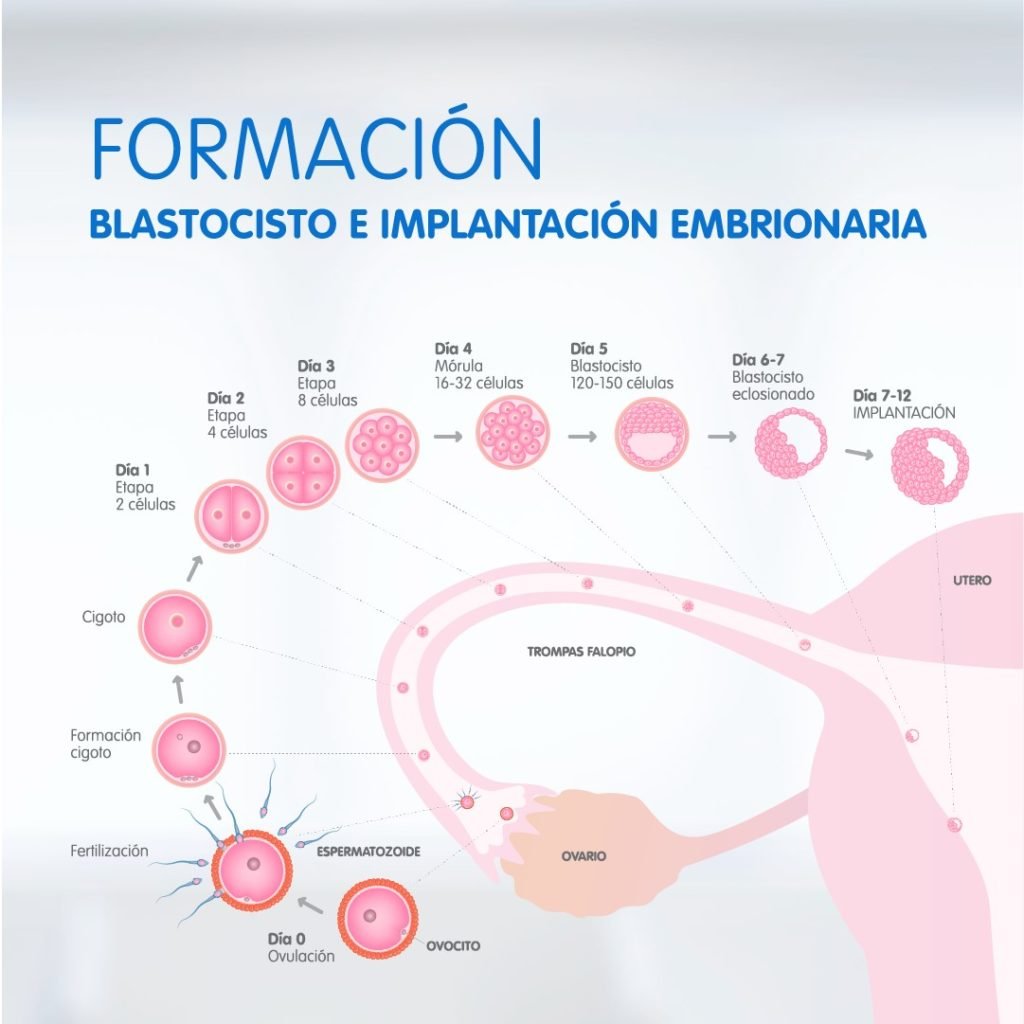
You can consult this other post, if you are interested in knowing what happens with the embryo development before implantation.
What color is the bleeding?
As we said, bleeding takes place between six and ten days after fertilization, a moment that usually coincides with the expected date for menstruation. But, unlike this, the bleeding is identified by being, normally, lighter, with a finer texture and less intense color. As well is usually darker, although it is not uncommon for it to be bright red or pink, although, again, lighter than that of menstruation.
Implantation bleeding does not follow a fixed pattern, and can occur in a single pregnancy or in all, indistinctly. As well spotting may occur coinciding with the luteal phase, which is due to a hormonal issue and is not directly related to implantation, although it could be confused with it.
Losses due to embryo implantation can last from one to three days, and the intensity of bleeding is easily detected since it is less than that of a normal menstruation, although this can vary enormously between women. But the most common is to observe the difference without problem.
How is implantation bleeding different from menstruation?
As we said, the main problem that confuses these two types of menorrhagia is their coincidence in time. But the essential difference is found precisely in the intensity of the spotting, which is much less than that of common menstruation. On the other hand, its duration is also a sign that we are facing implantation bleeding.
This can be from a few hours or sometimes lasts for several days as a mild, intermittent spotting, different from the more regular pattern of menorrhea. Along with bleeding after implantation, there may be a subsequent menstrual delay, pain similar to this, a slight swelling of the breasts, or even some slight imbalances: slight nausea, fatigue, etc.
However, it is important to know that this is not always indicative of a pregnancySince these symptoms are common in many other physical and emotional states, they are not infallible indicators to differentiate a menstruation from implantation bleeding.
Does it pose any risk to pregnancy?
No. There is no evidence to link bleeding after implantation with a problematic or ectopic pregnancy., to name an example. Of course, this type of bleeding cannot be linked to abortions or any other danger to the baby.
It is true that gestational problems, especially those related to abortion, can be associated with bleeding. But this, as with menstruation, it is noticeably more intense and usually comes with pain and other symptoms that identify it.
On the other hand, the ectopic pregnancies or miscarriages happen many times without any bleeding, so there is no reason to associate one phenomenon with the other.
What should I do if this bleeding occurs?
Although there is no reason to take special measures, in case of doubt it is advisable consult with your gynecologist. He will be the one who can confirm if it is a bleeding associated with the implantation of the embryo or not. The gynecologist will give you the guidelines to proceed in this regard in the best possible way and if necessary.
However, the bleeding after implantation, in most cases, it does not manifest itself with more than slight discomfort, in the worst case, so does not usually require any additional care. Still, proper assessment and care can help patients understand that this is part of the normal pregnancy process.
«Previous 1 2
3


