


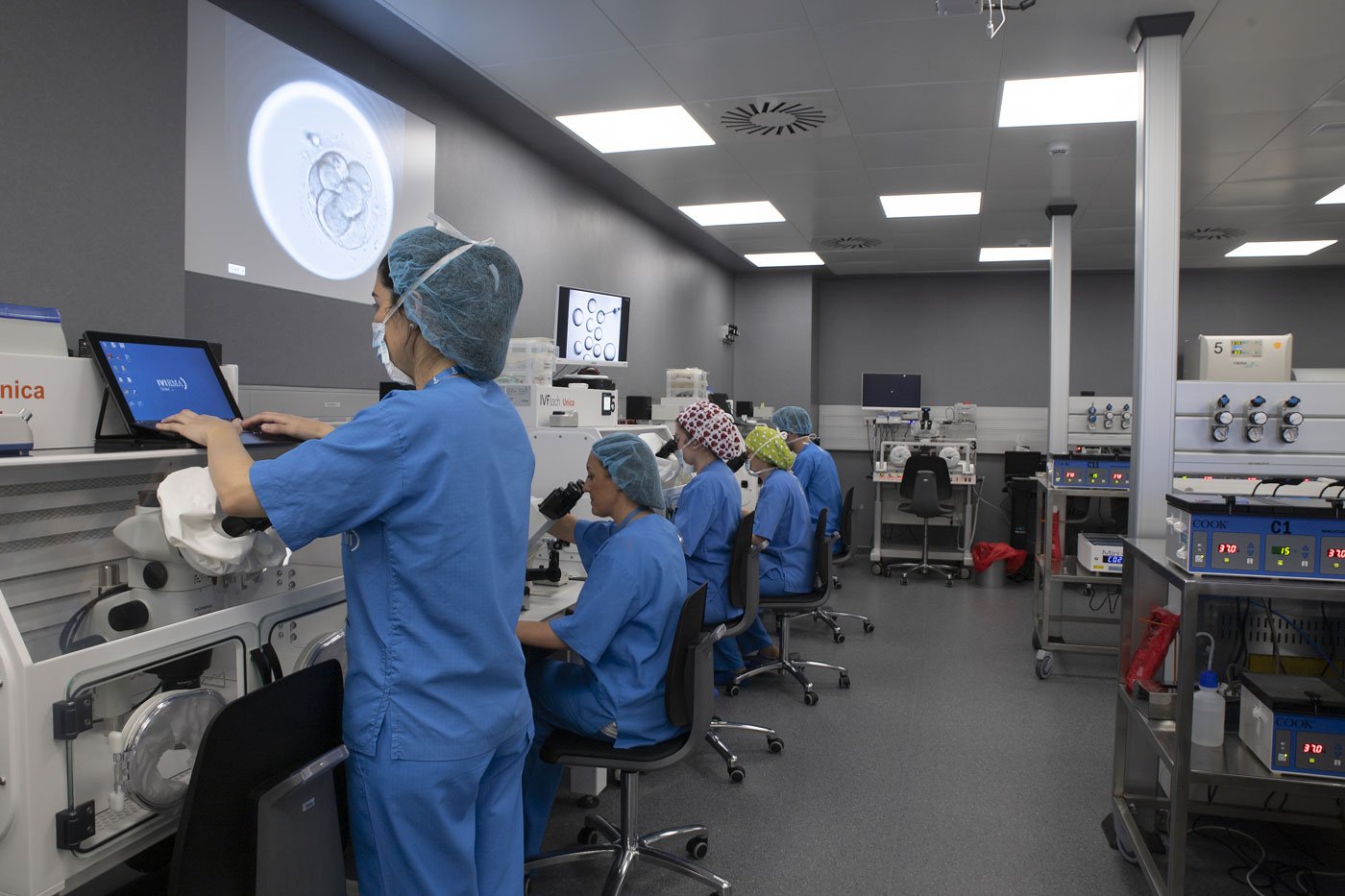
IVF laboratories are the true heart of assisted reproduction clinics. Authentic temples where science and love of life are shared equally. Giving them state-of-the-art technology and applying in them all the knowledge that our research work gives us is one of our main values. But how do you work in an in vitro fertilization (IVF) laboratory? How do we prepare the laboratories to generate the embryos?
We wanted to ask the doctor David Agudo, embryologist at IVI Madrid on these issues, and this post has passed us. We hope they clarify all your doubts.
I am David Agudo, I have been working in IVI Madrid’s IVF laboratory as a senior embryologist for 15 years, and I am also a consultant for the group’s embryology laboratories. I would like to tell you about how we prepare the IVF laboratories to receive your gametes, that is, your oocytes and sperm, to generate the best possible embryos and thus achieve your goal, which is also ours, that is, a healthy baby at home.
The IVF Laboratory, a complex laboratory
I have to say that the IVF laboratory is a very complex laboratory, whose main objective is to receive your reproductive cells, to obtain the largest number of embryos possible and of the best quality, and this is achieved with a lot of foresight and without leaving anything to improvisation. . The IVF laboratory preparation for the arrival of your eggs and sperm begins long before you even start your treatment., and we have to take into account a multitude of factors, such as the environmental conditions of the laboratory, the culture system, and the procedures that we will have to carry out in each case depending on the needs of each patient or couple.
As I mentioned previously, the environmental conditions of the laboratory must be controlled at all times, factors such as ambient temperature and humidity that must be kept constant throughout the year so as not to affect the stability of microscopes, work cabinets and embryo incubators … We also have to control the presence of volatile organic compounds, which must be kept at very low levels in the laboratory environment since they present a high toxicity for our embryos. These compounds are found in many plastics that we avoid within the laboratory, pBut we must also avoid perfumes, makeup, nail polishes, deodorants and cleaning products that present large amounts of these compounds. By last, we must minimize the possible presence of environmental pollutants as microorganisms and particles, These are exhaustively controlled and kept at very low levels at all times by complex air filtering systems that achieve a clean environment. and that allow us to obtain the best conditions for optimal human embryo culture. In addition to all this, we have another security system that prevents the entry of all these contaminants from outside the IVF laboratory, the system consists of introducing between 5 and 10 times the total volume of air that is in the laboratory previously filtered every hour, With this, a positive pressure is achieved within the laboratory that does not allow anything on a microscopic scale to enter the IVF laboratory, keeping it free of these contaminants.
Incubators in an in vitro fertilization laboratory
There are other more specific parameters of the embryo culture that we control very strictly before starting assisted reproduction treatments, such as the temperature and proportion of some gases (COtwo Itwo) in our incubators, we can already do this with measurements every few seconds in an automated way, since we have very sensitive probes inside all incubators, refrigerators and banks of semen, oocytes and embryos. These probes detect the slightest change that could affect embryo development and are connected to an alarm system that alerts embryologists in case a problem arises in the embryo culture system. We also control the pH of the culture medium, so important for embryos to develop, and we also keep the temperature of the work surfaces constant at 37 ° C, where the plates must be to perform the oocyte collection, perform the ICSI of the oocytes with the previously selected sperm, evaluate the embryo quality or carry out the embryo transfer to the maternal uterus. With all this we pursue, as far as possible, that the embryos feel as if they had never left the patient’s body. We even measure the temperature inside the drop of the culture medium where the embryo will be, to verify that all these measurements of work surfaces translate into the best possible conditions for embryo culture.
Culture plates in IVF laboratories
Furthermore, embryologists We take care of preparing the culture plates that we will need to carry out the specific procedures of each treatment one day in advance, In this way, the oocytes and sperm will find the culture media where they will be grown balanced in their incubators in the best possible conditions, in addition, depending on the characteristics of each patient or couple, we will have to prepare different types and number of culture plates For example, if we have a seminal sample that we know has little mobility, we know that we cannot do a conventional in vitro fertilization, then we will have to prepare all the necessary material to perform a microinjection or ICSI, and we need to know this with al at least one day in advance, so that the culture medium of the plates that we will use is correctly balanced and suitable for use.
Safe in vitro fertilization laboratories
Finally, a fundamental part of any medical treatment is to ensure the traceability of the samples., in this case gametes and embryos. For this, we register patients in our database, and we generate an identification system composed of a unique barcode for each patient, which will always be printed on all the plates where we cultivate gametes or embryos of the couple or the patient, these are automatically checked when it is necessary to change the plates for the correct embryo culture, in addition we assign a specific incubator for each couple or patient, in such a way that embryos or gametes from two patients will never share the same incubator.
As you can see, before your eggs and sperm arrive at the laboratory, the team of embryologists have worked hard to ensure the best possible conditions of safety and quality of the culture that we can offer you, I always say that the greatest task of embryologists is to ensure that the embryos and the cells from which they come, do not realize that they are in an environment other than their own, this undoubtedly favors them to develop in the best possible way.
I hope I have well conveyed to you the importance of prior IVF laboratory preparation for your treatments to be successful.
David Agudo
Embryologist
IVI Madrid


