


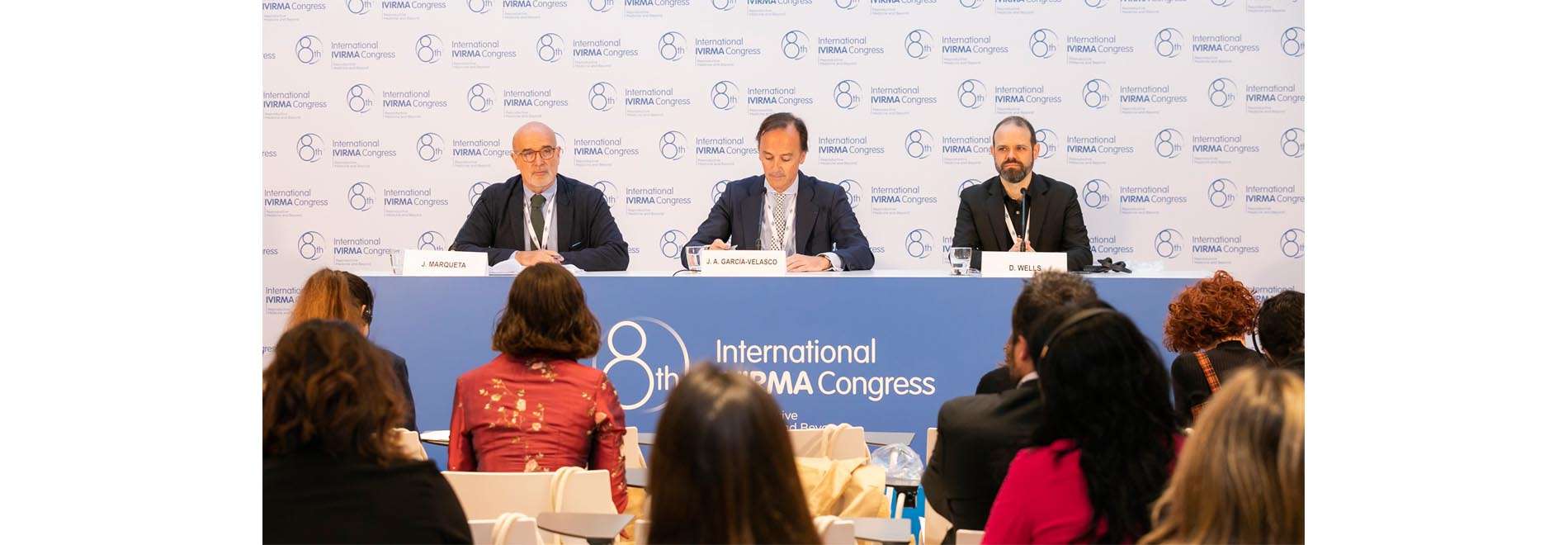
- Dr.Marqueta, director of #IVIMallorca and president of the 8th IVIRMA Congress: “Age is the most important genetic disease”
Genetics, male factor and embryonic quality. These are the main themes in which the contents of the 8th IVIRMA Congress. And so they have told it at a press conference this morning.
At the press conference we had the presence of different personalities: Dr. Marqueta, who is the president of the congress and also director of the IVI Mallorca clinic; Dr. García-Velasco, scientific director of this event and IVI Madrid specialist, and the Dr. Dagan Wells, who in addition to being a member of the scientific committee of the congress is also the director of our research center in Oxford, United Kingdom.
Dr. Marqueta, host of this edition of the congress in which we have received attendees from 68 nationalities, has highlighted the importance of science for IVI, as well as our commitment to maintaining both the facilities, the techniques and the staff always up to date . “In this edition we have had more than 1600 attendees, and we are proud to receive in Mallorca the greatest representatives of research and good practices in assisted reproduction”, he highlighted.
Dr. García-Velasco, Scientific Director, for his part underlined the growing interest aroused by Congress. “We have addressed the latest advances in the field of reproductive medicine,” he explained. The influence of metabolism, the study of extracellular vesicles and gene editing have been some of the star topics that we will undoubtedly hear more about in the coming years. “If you observe, we are in a gynecological congress, specifically, in a reproductive one, and yet genetics is present in everything we do. It’s like genetics coordinates everything, the future goes through knowing and researching this discipline »
In fact, Dr. Dagan Wells, has given this morning a conference on the possibilities of genetic editing of embryos to prevent the transmission of hereditary diseases. And this is achieved thanks to a technique called CRISPR that allows us to “cut” the parts of the DNA that are damaged and “paste” in their place other healthy ones. DNA is present in all the cells of the body, so it is clear that it is much more practical to look for these damaged sequences in one or a few cells of an embryo than in all the millions of cells that the human body has when we are already born. not?
Gene editing certainly has many possibilities, but it is also very controversial. Remember the controversy that was generated just a few months ago with the news of the Chinese baby whose DNA had been modified. At the moment, at IVI we are going to study these techniques, but “not because we contemplate their clinical application in the immediate future, but because it will allow us to answer basic questions about the biology and development of human embryos”, explained the director of the Oxford Research Center.
And, as you know, research is one of our pillars because at IVI we are very clear that the best way to help our patients is by dedicating all our efforts to keep reproductive medicine moving forward.


